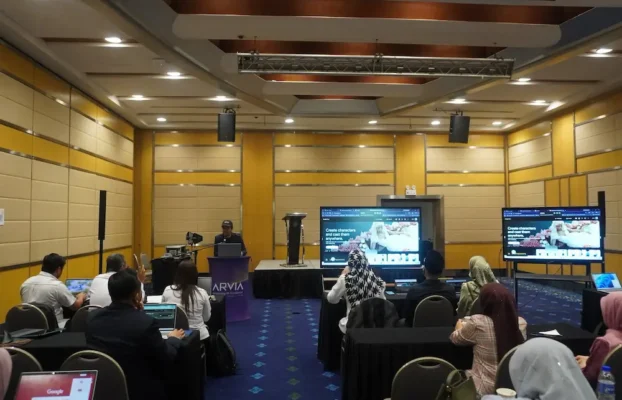
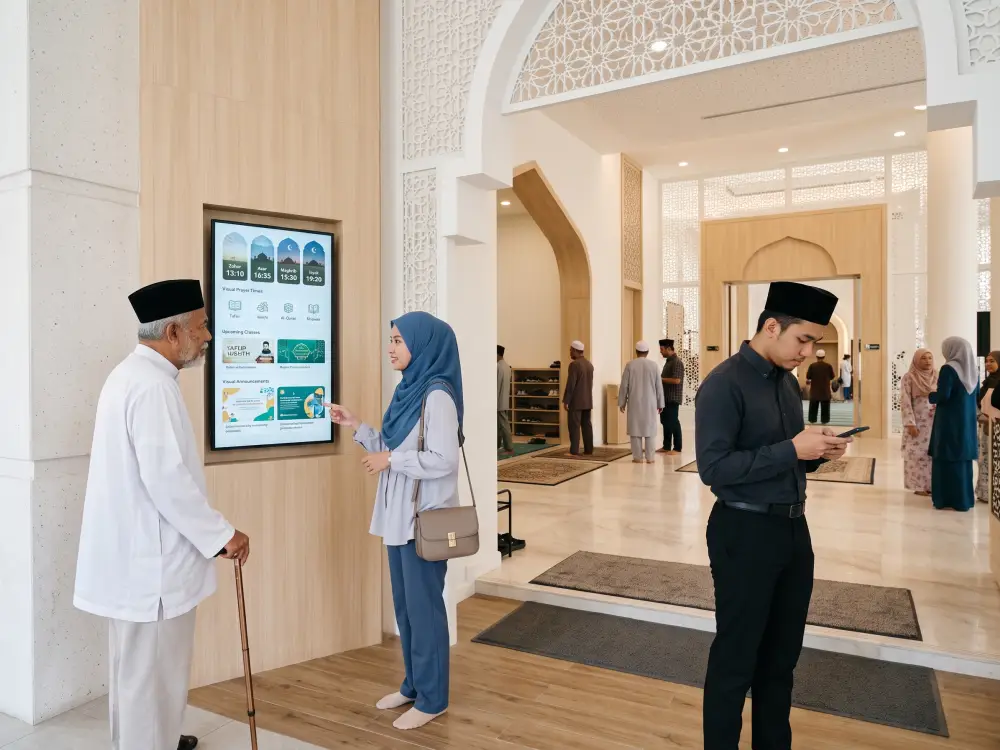
Community expectations are changing as people become accustomed to receiving clear and timely information digitally.
Why Masjid Digitalization Is Growing Now
The growing interest in digital systems is connected to a much broader change in Malaysian society. People now use smartphones and online platforms for communication, learning, appointments, payments and access to public information. According to the Department of Statistics Malaysia’s 2025 ICT survey, individual internet usage in Malaysia reached 98.3%. Household internet access was reported at 99% in urban areas and 90.7% in rural areas. This does not mean every masjid activity should move online. It does mean that many community members now expect important information to be current, easy to find and accessible through familiar digital channels. Masjid committees are responding by modernising selected processes while preserving the spiritual and community-centred character of the masjid.It Is Not About Replacing Tradition
The word “digitalization” can sometimes create the impression that traditional practices are being removed. In a masjid environment, that should not be the objective. A digital Quran learning display does not replace the printed mushaf. An interactive smartboard does not replace an ustaz. A digital announcement screen does not remove the importance of personal communication between committee members and congregants. Instead, technology adds a supporting layer. It can make visual information clearer, reduce repetitive administrative work and help programmes reach people who may otherwise be excluded. The strongest digital transformation projects are often the ones where technology remains almost invisible. The system works when needed and does not interfere with worship, reflection or face-to-face interaction.Changing Expectations Around Masjid Information
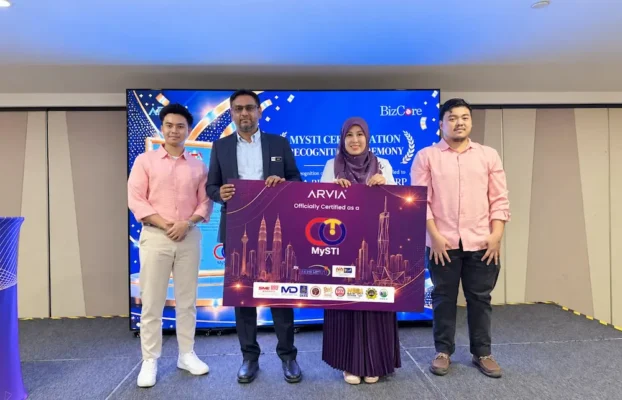
One of the clearest drivers of masjid digitalization is the need for faster and more consistent communication. A busy masjid may manage daily prayer times, religious classes, Friday programmes, charity campaigns, funeral notices, community services, youth activities and special events. When this information is distributed through separate posters, messaging groups and verbal announcements, details can become inconsistent or outdated. Digital signage allows authorised committee members to organise announcements in a consistent format and update them without repeatedly printing new material. Prayer-time information can be checked against an authoritative platform such as the official JAKIM e-Solat portal, while local notices can be managed by the masjid. Systems such as Arvia digital signage can also support central scheduling and remote content updates. This is particularly useful when several screens or different information zones need to display coordinated content.Religious Learning Is Becoming More Visual
Another major trend is the use of visual and interactive material during religious education. Younger community members are already familiar with digital learning at school, university and work. Adults also regularly use online videos, presentations and digital references to learn new subjects. Masjids are beginning to introduce similar supporting tools in Quran classes, lectures, seminars and committee training. An interactive smartboard allows an ustaz or facilitator to display structured notes, annotate teaching material, enlarge important references and play suitable educational media. The audience can follow the same visual content without depending entirely on a small projector image or individual printed handouts. This approach is already visible in Malaysian projects. The AI Smartboard and FlipTouch deployment at Masjid Jamek Al-Ikhwan supports religious learning, presentations and community-based activities through both fixed and portable interactive displays.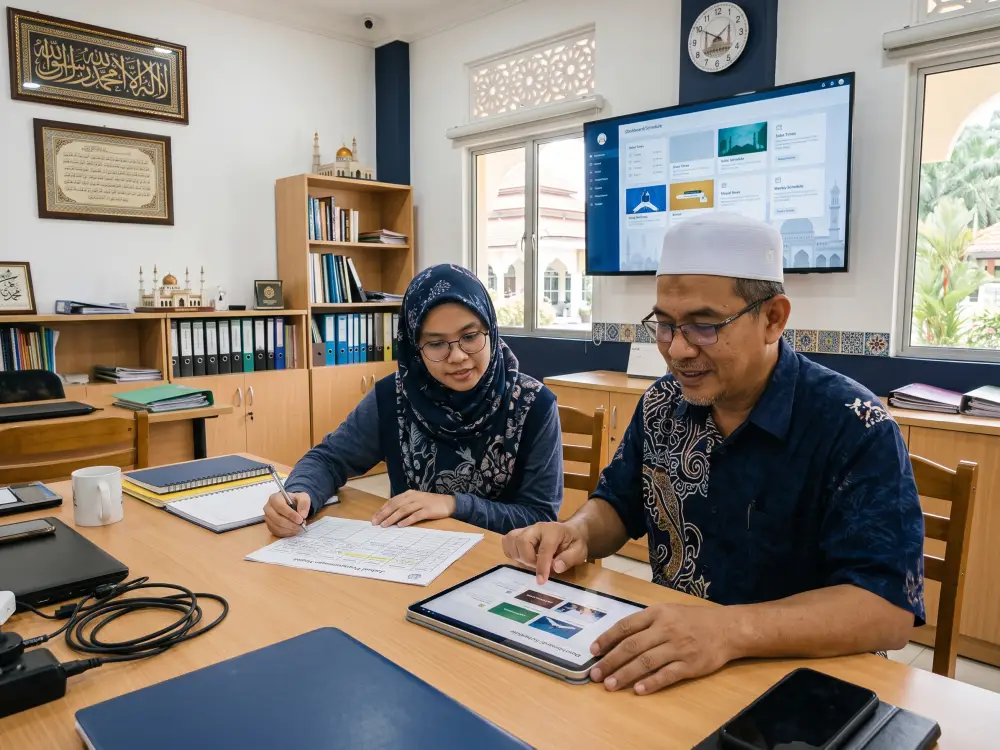
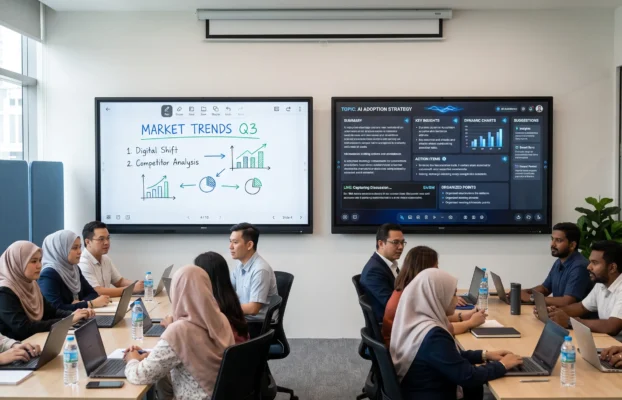
Central content management can reduce repetitive work and help volunteers keep information consistent.
Volunteers Need More Manageable Systems
Masjid programmes depend heavily on committee members and volunteers. Many of them balance masjid responsibilities with employment, family commitments and other community work. Repeatedly designing posters, printing updates, changing display boards and assembling presentation equipment can consume time that could be used for more meaningful responsibilities. Digital systems can simplify some of this work. Announcements may be scheduled in advance. Frequently used presentation material can be stored in one place. Standard content templates can help different volunteers maintain a consistent visual style. However, good masjid digitalization should reduce complexity rather than introduce more of it. The system should not depend on one technically skilled individual. Several committee members should receive basic training, and the most important procedures should be documented clearly.The Shift from Individual Products to Connected Systems
Earlier technology upgrades were often treated as separate purchases. A television was installed in one area, a projector was placed in another room and a camera was purchased for occasional streaming. The newer trend is to consider how these tools work together. Digital signage manages public information. An interactive display supports learning and meetings. A portable touchscreen moves between smaller programme spaces. Video conferencing tools enable selected hybrid sessions. This does not mean every masjid needs every product. It means that each purchase should be compatible with a longer-term plan.| Earlier Approach | Emerging Digitalization Approach | Community Benefit |
|---|---|---|
| Purchase individual screens when needed | Plan displays according to communication and learning zones | Better visibility and fewer unnecessary devices |
| Update every notice manually | Use scheduled and centrally managed digital content | Faster and more consistent announcements |
| Assemble projector equipment for each class | Use an integrated interactive display | Less setup time and clearer visual learning |
| Keep presentation tools fixed in one room | Add portable displays for shared use | More flexibility across different programmes |
| Provide activities only to physical attendees | Offer hybrid access for selected suitable sessions | Stronger connection with members unable to attend |
| Depend on one technical volunteer | Train several users and document basic procedures | More sustainable daily operation |
Smaller and More Flexible Technology Is Accelerating Adoption
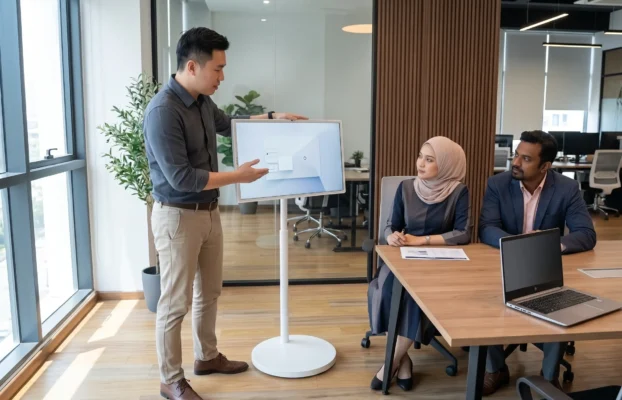
Another reason more masjids are considering digitalization is that technology is becoming more flexible. Digital transformation no longer requires every device to be permanently installed in a large hall. A portable touchscreen such as the Arvia FlipTouch can move between Quran classes, committee meetings, youth programmes, registration areas and smaller learning groups. Its height adjustment also makes it suitable for floor-level viewing arrangements commonly used in religious learning. This gives committees the option to begin with one shared device and observe how it is used before expanding the setup. A phased approach is often more effective than attempting to modernise the entire masjid at once. It gives volunteers time to learn, allows the community to adapt and helps the committee identify which technology creates genuine value.Accessibility Is Becoming Part of the Conversation
Masjid communities include children, teenagers, working adults, elderly congregants and people with different levels of mobility, vision and hearing. Digitalization creates opportunities to make information more accessible. Large text can improve readability. Clear colour contrast can make announcements easier to understand. Visual lesson material can support participants sitting farther from the teacher. Remote access can help selected community members join a programme from home. The W3C guidance on designing for older users highlights the importance of readable text, simple navigation and interfaces that account for changes in vision, hearing and physical ability. These principles are useful when designing content for masjid screens and interactive systems. Digital information should still be supported by alternative communication methods. Important announcements may also need to be shared verbally, through messaging platforms or in printed form. Inclusion means offering more ways to receive information, not forcing everyone to use only one channel.Real Projects Are Making the Trend More Visible
Masjid digitalization is no longer only a future concept. Practical installations are already demonstrating how technology can support specific activities. For example, Masjid Bilal Bin Rabah introduced digital signage to improve the communication of prayer times, announcements and community updates. Masjid Taman Temerloh Jaya implemented an interactive smartboard to support meetings and presentation requirements. These examples are important because they show that digital transformation does not follow one fixed template. One masjid may prioritise communication, while another begins with learning or administration. Our guide to seven essential digital masjid technologies in Malaysia provides a wider overview of the available solution categories and their possible uses.What Could Slow the Trend Down?
Although adoption is growing, several challenges can prevent technology from delivering lasting value.-
- Purchasing without a use plan: Equipment may remain underused when no clear activity or responsible user has been identified.
-
- Overcomplicated systems: Volunteers may avoid using a platform if everyday updates require too many technical steps.
- No content ownership: Screens can quickly display outdated material when nobody is assigned to review and remove announcements.
- Insufficient training: Depending on a single operator creates operational risk when that person is unavailable.
- Poor placement: Displays may be difficult to read or may distract from worship when location, brightness and viewing distance are not considered.
- No maintenance planning: Internet connectivity, software access, cables and hardware support need to be considered beyond installation day.
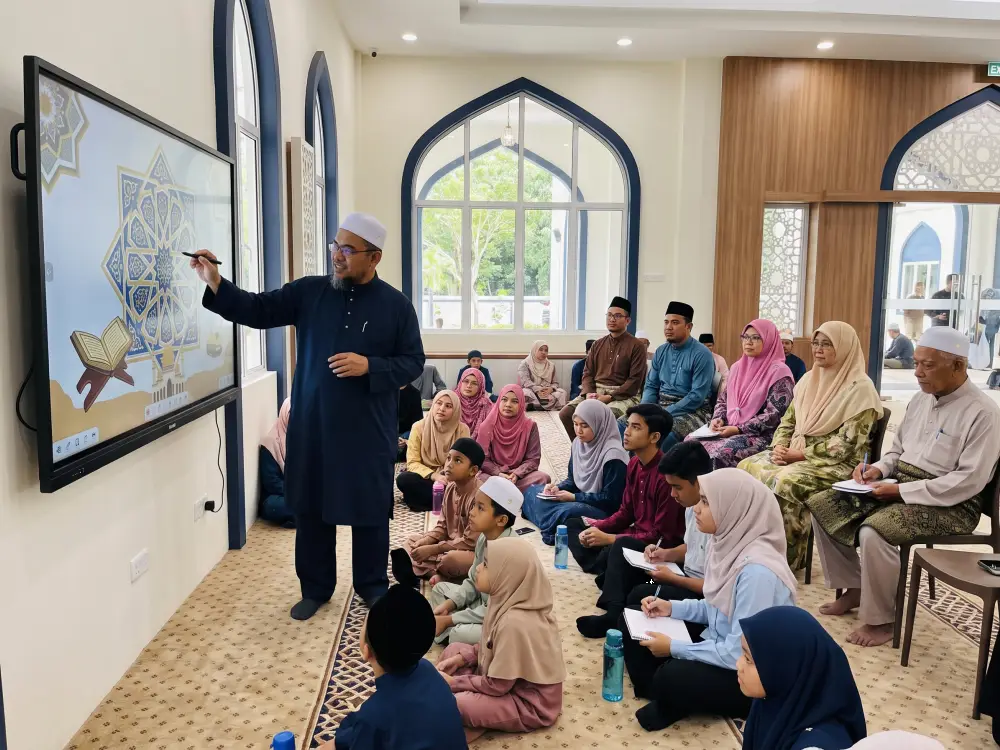
Successful digitalization connects generations while preserving direct learning and community interaction.